My purpose is to collaboratively create conditions that foster the flourishing of our civilisation by cultivating leadership, strengthening our ability to navigate complexity, and relentlessly pursuing truth.
The activities listed in my bio are simply means through which I work towards this overarching purpose.

Three ideas at the heart of my work
Understanding the nature of complexity, different types of complexity, how complexity applies to social systems and leadership, and learning to navigate it more skilfully.
Understanding and cultivating leadership as a process of influence that fosters systemic health.
Distinguishing between beliefs, meaning, knowledge, and truth, and relentlessly pursuing truth as a necessary condition for the future of our civilisation.
Complexity, leadership and truth
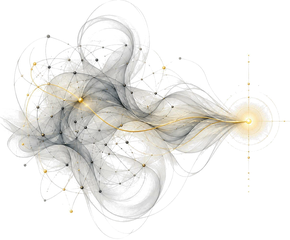
The logo brings together my focus on complexity, leadership and truth in a unified visual form. The intricate web of interconnected lines represents the complexity of the systems, relationships and perspectives leaders must navigate; the golden thread represents leadership as a process of influence that fosters systemic health; and the point of light represents truth, not as a simplistic sense of certainty, but as an ongoing orientation towards greater correspondence with reality and knowledge of the complexities of the world we inhabit.
What would you like to learn about?

About me
Hi, I’m Aiden. Everything I do sits at the intersection of complexity, leadership, and truth. I’m a complexity leadership scientist, management consultant, psychometrics entrepreneur, street epistemologist, ACMP Board Director, public speaker, and podcaster. I bring a distinctive blend of intellectual intensity, pragmatic insight, and wicked humour to all my work.
My purpose is to collaboratively create conditions that foster the flourishing of our civilisation by cultivating leadership, strengthening our ability to navigate complexity, and relentlessly pursuing truth.
The activities listed below are simply means through which I work towards this overarching purpose.
As a complexity leadership scientist, I have been immersed in the complexity, systems, and leadership literature for the best part of 20 years. I hold an interdisciplinary PhD in leadership, complexity, and cognition, which was rated in the top 5% of Higher Degree Research projects. I am an Adjunct Associate Professor of Complexity Leadership at Swinburne University’s School of Business, Law and Entrepreneurship, and Co-Founder and Co-Director of the Swinburne University Complexity Leadership Science Lab. I am the Lead Complexity Scientist at Self-Stacked Systems, a global research collaborative focused on applying the Model of Hierarchical Complexity across a range of disciplines, including leadership, the social sciences, AI, robotics, and computer science. I am an Honorary Associate in Leadership Psychometrics at the Centre for Educational Measurement and Assessment (CEMA) at the University of Sydney, one of the most highly ranked universities in the world. Finally, I am a member of several global networks of professional psychometricians focused on applying principles of metrology (i.e., the science of measurement) to strengthen measurement in the social sciences.
As a management consultant, I bring over 25 years of international experience across Australia, Asia, and Europe, working with top-tier consulting firms and blue-chip organisations. I have led large-scale, multinational, and multimillion-dollar programs impacting up to 40,000 people and now run my own consulting practice specialising in complexity leadership, operating models and organisational design, organisational transformation and change leadership, organisational culture change, human capital consulting, and leadership development.
As an entrepreneur, I have co-founded a start-up called Integrative Leadership Psychometrics (ILP) with Dr Roy Kong. We collaborate with professional psychometricians to offer a suite of new generation psychometric tools relevant to complexity leadership. We have developed the world’s first psychometric tool to measure the complexity of leaders’ sensemaking skills, called the Integrative Leadership Sensemaking Profile (ILSP). A variety of other psychometric tools related to complexity leadership are also on the way. Our broader mission is to strengthen the application of metrology to the school of complexity leadership.
As a street epistemologist, I am deeply engaged in creating conditions for diverse groups to constructively explore controversial socio-political issues. In this context, my work focuses on examining what people believe, why they hold those beliefs, and the epistemological foundations that underpin them. As someone who almost went down the path of becoming a professional philosopher specialising in theory of truth, I argue that the pursuit of truth is a necessary condition, and an often overlooked capability, for leading through the complexities of the 21st century and securing a future for our civilisation. For an introductory discussion on the nature and importance of truth, please check out these two podcasts (link 1, link 2). For a formal philosophical treatment of the twofold objectivity of facts and truth, please refer to this paper by Professor Howard Sankey from the University of Melbourne that has informed my thinking (link).
I serve on the Board of Directors of the Association of Change Management Professionals (ACMP) Australia and New Zealand, where I play a key role in strategy development and thought leadership.
I regularly speak publicly and podcast on topics related to complexity, leadership, and truth.
Outside of work, I am an avid reader (mostly on meta-theory, theory of truth, current affairs, and the culture wars), play competitive tennis, am a passionate bonsai keeper, and regularly practise yin yoga, breathwork, biofeedback, yoga nidra, and a transcending form of meditation.

Advancing the science of complexity leadership
What is complexity leadership?
Why focus on science?
Who do we work with?
What research are we undertaking?
How can you partner with us?

Management consulting
Six areas of practice
I have worked for, and collaborated with, some of the world’s most prestigious management consulting firms, including Booz & Company (formerly Booz Allen Hamilton), PwC, Capgemini, Deloitte, and Grant Thornton. Across these settings, I have led large-scale, multinational, multimillion-dollar programs and have been consistently recognised for my leadership and consulting ability. I now run my own management consulting practice, focused on the following six areas:
Complexity leadership consulting
I bring together deep expertise in the science and practice of complexity leadership, grounded in 20 years of immersion in the complexity, systems and leadership literatures and more than 25 years of international leadership and consulting experience in highly complex contexts. Drawing on this combination, I offer a range of complexity leadership consulting services, including:
- Expert advisory services for leaders, executive teams and organisations navigating complex challenges
- Complexity Leadership Lab: Foundations of Leading Through Complexity, an intensive two-day program introducing the foundations of complexity-informed leadership
- Complexity Leadership Program: Building Capability to Lead in Complexity, a 10–12 month development program designed to build sustained capability for leading in complex conditions
- Model of Hierarchical Complexity workshops, focused on applying key ideas from the Model of Hierarchical Complexity to navigate complex real-world challenges
Operating models and organisational design
ExampleLed the design of an enterprise operating model, governance framework, and transformation roadmap for a major government agency, improving service delivery, reducing operational expenditure, and impacting approximately 10,000 FTE
Organisational transformation and change leadership
ExampleLed the design and delivery of a global change management strategy for a financial services organisation impacting approximately 40,000 FTE, enabling enterprise-wide transformation execution and accelerating adoption
Organisational culture change
ExampleCo-led cultural diagnostics and transformation during a large-scale M&A impacting approximately 6,000 FTE, informing integration strategy and enabling successful alignment of organisational cultures
Human capital consulting
ExampleLed the design and implementation of a global HR strategy for an Asia-based financial services organisation, strengthening the HR operating model and improving service delivery across the employee lifecycle
Leadership development
ExamplePlayed the role of master architect and mentored 10+ senior leadership development providers in designing an executive development initiative for the top 1,500 leaders at a major telecommunications organisation
Illustrative examples of organisations I have worked with (along with many others)


 Financial services





 FMCG and retail
 Management consulting




 Mining, manufacturing and engineering
 Not-for-profit

 Public sector



 Telecommunications

Financial services
Management consulting
Public sector
Not-for-profit
FMCG and retail
Mining, manufacturing and engineering
Education
Telecommunications

Measuring constructs relevant to complexity leadership
My interest in measurement is driven not by a personal fascination with psychometrics, but by a longstanding challenge in the school of complexity leadership. The lack of sophisticated approaches to measurement has meant that the field has been dominated by theorising, conceptual commentaries, qualitative research on relatively small samples, and practice-based approaches. More rigorous approaches to measurement are needed to support rigorous scientific research on complexity leadership, strengthen its empirical foundations, and enable the school of thought to contribute more meaningfully to some of the most pressing questions about leadership in the world today.
To develop a new generation of psychometric tools* grounded in principles of metrology (i.e., the science of measurement) for measuring constructs relevant to complexity leadership.
*Note: In psychometrics, we typically use the term “instrument” rather than “tool”. However, throughout this website, we use “tool” to make the language more accessible to a broader audience.
Despite decades of effort, the measurement of leadership leaves much to be desired.
Many existing tools:
- are not grounded in the principles of metrology
- have not been thoroughly validated
- have not been consistently shown to predict meaningful outcomes, e.g., leadership performance
- do not clearly measure constructs relevant to complex, changing, ambiguous 21st-century conditions
- focus narrowly on psychological and behavioural attributes of individual leaders at the expense of everything else
- assess constructs that may not develop significantly over time
- and so on ...
The risk of not addressing these issues
- Providing leaders with false or misleading feedback about their strengths and growth opportunities
- Prioritising the less relevant capabilities for development initiatives
- Investing in developing capabilities that do not translate into better leadership outcomes
- Inability to determine whether leaders have actually developed over time
And this raises an uncomfortable question: Are we measuring what really matters for leadership today and in the future?
Why high-quality measurement matters
Robust measurement is necessary for advancing the science and practice of complexity leadership because it enables:
- accurate measurement of genuine strengths and development opportunities
- meaningful and accurate feedback provided to leaders
- informed decision-making about the design of leadership interventions
- tracking development over time, e.g., pre-, during, and post-interventions
- high-stakes decision-making such as executive selection, talent identification, and succession planning
- credible research that builds a scientifically grounded understanding of leadership
My work in psychometrics includes
Provision of expert advice and workshops on measurement
An exploratory workshop to understand your measurement needs
Integrative Leadership Sensemaking Profile (ILSP)
The world’s first tool to measure the complexity of leaders’ sensemaking, developed in collaboration with a professional psychometrician
Organisational complexity diagnostics
Several more psychometric tools on the way

Public speaking and engagement opportunities
If you’d like to take a deeper dive into my work and engage with me directly, explore the following opportunities.
Upcoming in 2026
Yesterday’s change won’t deliver tomorrow’s organisations: Unlearning, complexity, and the future of change leadership
An evening event on change leadership, in collaboration with the Association of Change Management Professionals (ACMP) Australia and New Zealand.
A one-day event on complexity leadership and other salient social topics in Australia
In collaboration with the Swinburne University Complexity Leadership Science Lab and the Swinburne University Design Factory.
An executive breakfast on complexity, leadership and AI
In collaboration with the Swinburne University Complexity Leadership Science Lab and several collaborative partners.
If you’d like to enquire about or schedule a new engagement, please get in touch.
Recent engagements
Presentation and panel discussion on leadership in Tasmania
In collaboration with Tasmanian Leaders.
Discover how complexity science informs the future of change leadership
A keynote presentation in collaboration with the Association of Change Management Professionals (ACMP) across Southern Africa, Australia and New Zealand, and Singapore.
Leading Through Complexity: Skills for a Changing World
Co-facilitating the program in collaboration with Tasmanian Leaders.
Keynote presentation on complexity leadership
In collaboration with the European Society for Research in Adult Development.
Keynote presentation on complexity leadership
In collaboration with enfac Corporation, Japan.
Launch of the pilot study on the Integrative Leadership Sensemaking Profile (ILSP)
The world’s first psychometric tool to measure the complexity of leaders’ sensemaking abilities. Read more on the Psychometrics page →

Conversations on complexity, leadership and truth
Leadership: Navigating Complexity
Introduction to Leadership and Complexity
November 2024 · With Dr Kerry ElliottIn this episode, host Dr. Aiden Thornton delves into the concept of complexity leadership with guest Dr. Kerry Elliott. Together, they explore how leadership has evolved to address today’s interconnected challenges, underscoring the importance of collective approaches and adaptive skills. Their conversation highlights the need for innovative tools and strategies to navigate complex environments, setting the foundation for deeper insights in the episodes to come.
The Fundamentals of Complexity Theory
November 2024 · With Distinguished Professor Geoffrey WestIn this episode, host Dr. Aiden Thornton explores the fundamentals of complexity theory with Shannan Distinguished Professor Geoffrey West. The conversation highlights the importance of understanding complex adaptive systems—networks with many interconnected parts that exhibit emergent properties. West emphasises that these systems, such as cities, are more than just the sum of their individual components. He also discusses the Institute's unique structure, which fosters interaction among a small group of scholars and visitors, allowing for dynamic exchanges of ideas without the rigidity of tenure.
Real-World Examples of Complexity Leadership
December 2024 · With Jackie O’Dowd, Founding Partner and CEO of Realising-PotentialIn this episode of the Leadership Navigating Complexity podcast, host Dr. Aiden Thornton speaks with Jackie O'Dowd, CEO of Realising Potential, about complexity leadership and its practical applications in today's business environment. Jackie shares her insights on the challenges faced by senior leaders, emphasising the struggle to align strategies, engage employees, and deploy technology effectively. She discusses the paradox leaders encounter between maintaining current customer satisfaction while preparing for future demands.
Bridging Theory and Practice in Complexity Leadership
December 2024 · With Professor Christopher Pietroni and Dr Rachel LilleyIn this episode of the Leadership Navigating Complexity podcast, host Dr. Aiden Thornton speaks with Professor Christopher Pietroni and Dr Rachel Lilley about whether leadership truly makes a difference, particularly in the context of global populism and its impact on organisational narratives. The discussion delves into how leaders often resort to simplified, comforting messages to address complex issues, exploring the implications of this trend on both political and organisational levels. They examine the need for leaders to balance simplicity and complexity in communication, emphasising the importance of revealing genuine dilemmas to engage their teams effectively.
The Neuropsychology of Complexity Leadership
January 2025 · With Dr Jess Herrington, ANU School of CyberneticsIn this episode, the discussion delves into the fascinating intersection of neuroscience, leadership, and complexity. Dr Herrington brings her expertise in visual neuroscience to explore how the human brain processes patterns, textures, and the impacts of neurodegenerative diseases such as Parkinson's. The conversation shifts to the intricate ways leaders' brains manage complexity, focusing on the critical roles of the prefrontal cortex, thalamus, and basal ganglia in metacognition, decision-making, and inhibition.
This episode also examines how stress influences problem-solving, emphasising the delicate balance between maintaining cognitive engagement and avoiding overwhelm. By understanding these dynamics, leaders can optimise their executive functioning and navigate complex challenges more effectively. Whether you're a leader, a neuroscience enthusiast, or simply curious about the brain's role in tackling complexity, this episode will inspire you to think deeply about how we approach leadership in an interconnected world.
On the Measurement of Leadership
February 2025 · With Dr Matt Barney and Professor John Antonakis, University of LausanneIn this episode of the Leadership Navigating Complexity podcast, host Dr. Aiden Thornton speaks with Dr Matt Barney & Professor John Antonakis about the challenges of accurately measuring leadership behaviour, differentiating it from mere perceptions, which are often influenced by biases. Dr. Barney discusses advances in AI that enable the capture of precise behavioural data, a "game changer" in leadership evaluation, while Professor Antonakis highlights issues around traditional behavioural assessments and the importance of understanding nuanced perceptions.
Systems-Based Approaches to Fostering Leader and Leadership Development
February 2025 · With Professor Katherine Daniell, ANU School of Cybernetics, and Professor David V. Day, Kravis Leadership Institute, Claremont McKenna CollegeIn this episode of the Leadership Navigating Complexity podcast, host Dr. Aiden Thornton speaks with Professor Katherine Daniell & Professor David V. Day. The conversation focuses on the distinctions between leader and leadership development, and between event-based, practice-based, and systems-based approaches to development. David highlights that while traditional leadership development focuses on individuals, effective leadership development should aim to enhance the collective capacity of groups or organisations, especially in addressing complex challenges. Catherine echoes this viewpoint, noting that her cybernetics program focuses on collective development, selecting entire cohorts rather than individuals to foster systemic change.
Where Do We Go From Here?
March 2025 · With Professor David V. Day, Professor Samuel Wilson, Dr Kerry Elliott and Scott KoIn this episode of Leadership: Navigating Complexity, host Dr. Aiden M.A. Thornton is joined by a distinguished panel of leadership scholars and practitioners to explore the evolving challenges of leadership in an era of rapid change. Featuring Professor David V. Day, Professor Samuel Wilson, Dr. Kerry Elliott, and strategist Scott Ko, the discussion delves into key issues such as social divisiveness, polarized thinking, epistemic complexity, and burnout in a world of constant disruption. The conversation examines the struggle to align diverse worldviews, the limitations of binary thinking and quick fixes, and the role of connection and shared meaning in fostering progress. With insights into the transformative impact of AI on leadership, this episode offers thought-provoking perspectives for leaders, strategists, and anyone navigating complexity in an ever-changing world.
Panel discussions
How can leaders and organisations skilfully adapt to our increasingly complex world?
March 2025ACMP ANZ Panel Discussion 31 March 2025
Topic: How can leaders and organisations skilfully adapt to our increasingly complex world?
Host: Peter Cully, President ACMP ANZ
Panelists: Dr Aiden Thornton, Megan Tyler, Rory van der Merwe
Facilitator: Brad Rilatt, Vice President ACMP ANZ
What are the implications of implementing GenAI for organisations, leaders, and people?
July 2025ACMP ANZ webinar on the implications of implementing GenAI for organisations, leaders and people
Rising to the Occasion
Understanding Complexity and the Case for Complexity Leadership
March 2026In this episode, I speak with Dr. Aiden Thornton to unpack what complexity actually is, why it's been increasing for thousands of years (in some ways- but not all!), and what it really means for how we lead.
In the first episode of our four-part mini-series, complexity leadership scholar and management consultant Dr. Aiden Thornton joins us to explore one of the most important and most misunderstood topics in leadership today.
Together we dig into the crucial difference between complexity and difficulty, why our instinct to simplify everything might be doing us more harm than good, and what leadership really is (hint: it's not a role or a title). Aiden also shares his definition of leadership as a process of influence that fosters systemic health, a reframe that might just change how you think about your own role, whatever level you're operating at.
Whether you're a seasoned leader, an emerging one, or someone trying to make sense of an increasingly complex world, this conversation is a powerful place to start.
Leadership Skills for the Modern Era
April 2026In Episode 1 we established that complexity is increasing. Now we go one step further to ask: are we as humans actually built to handle this level of complexity? And what skills do leaders need to navigate it moving forward?
In Episode 2 of this mini-series, Dr. Aiden M. A. Thornton shares eye-opening research on the gap between what leadership roles demand and what most leaders are cognitively equipped to handle.
Then we go beyond the problem to explore the emerging leadership skills needed to thrive amid increasing complexity in today's hyper-connected, unpredictable world.
We cover:
- What 700 leaders revealed about the relationship between cognitive capacity and role complexity
- The key skills leaders need to navigate complexity effectively
- What regulating your own nervous system has to do with navigating organisational complexity
Whether you lead a team, drive change, or simply want to show up more effectively in an increasingly complex world, this episode will shift how you think about what leadership actually requires of us.
Culture Wars and Colliding Worldviews
April 2026Something has shifted in society. Most of us can feel it, but few of us have the language to explain it.
In Episode 3 of my mini-series with complexity leadership scholar Dr. Aiden Thornton, we explore the topic of the culture wars, why our conversations across difference so often go nowhere, and what we can do about it as individuals and leaders.
You will come away with:
- Why people with different worldviews are not just disagreeing, but operating from entirely different realities
- Some of the major worldviews shaping today's culture wars and how to recognise them
- Why acknowledging diverse perspectives and pursuing true ones are not the same thing
- Practical tools for having more constructive conversations across deep disagreement
If you have ever felt frustrated, confused or exhausted by the state of public discourse, this episode will give you a clearer picture of why things feel the way they do, and a more grounded place to stand within it.
Truth: What it is and why it matters for leading in a complex world
April 2026We talk about truth constantly, be it directly or indirectly. We invoke it in arguments, base decisions on it, and build entire worldviews around it. But how often do we stop to ask what truth actually is, why it matters, and how we can reliably identify it?
In Part 4 of our complexity leadership mini-series, Dr. Aiden Thornton and I dig into exactly that. Working through four core questions, we unpack what truth actually means, why it matters for how we lead and live, how to identify or at least approximate it, and why the question of who gets to decide what is true might be based on a flawed premise entirely.
We cover:
- The crucial difference between truth, belief and meaning, and why conflating them can cause more harm than we realise
- Why the truth of our beliefs is what allows us to interact with both our internal and external world
- How to match the right method to the right claim when trying to identify or approximate truth
- Why "who gets to decide what's true" is actually the wrong question entirely
- Why a mature understanding of truth may be a necessary condition for the survival of our species in the 21st century
Q&A: Practical Questions
May 2026You asked, we answered! This is the first of two bonus Q&A episodes following our four-part complexity leadership mini-series. Here, Dr. Aiden Thornton responds to your practical questions about leading in a complex world, addressing:
- The five issues Aiden has his eye on as the most complex challenges facing leaders today, from the future of AI and work to the role of truth
- A practical three-step framework for developing complexity leadership skills, and why daily practice often matters most
- How to start untangling complexity when everything feels complex at once, including what to look for and where to begin
- Why collective leadership is not automatically the best answer to complexity, and what the evidence actually suggests
- How to navigate conversations about the culture wars without shutting them down or causing unnecessary offence
Whether you are new to the series or have been following along from the beginning, this episode brings the concepts to life with concrete, actionable insights you can start applying today.
Truth, Worldviews and Assumptions Shaping Complexity Leadership
June 2026Can there be multiple truths? Is truth only something only science can establish? Do postmodern and critical social justice worldviews represent more advanced stages of adult development? And when leaders struggle to stay clear under uncertainty, are they hitting a complexity ceiling, or is something else at play?
In our first Q&A episode, Dr Aiden Thornton and I tackled the practical questions. Now, we go deeper to unpack some of the assumptions, ideas, and evidence that sit beneath complexity leadership practice.
You will come away with:
- A clearer understanding of what we mean when we talk about "truth" and why it matters for leadership in complex environments
- New ways to think about the relationship between truth, evidence, science, and lived experience
- Greater insight into the debate around postmodernism, critical social justice, and adult development
- Practical perspectives on what may be happening when people struggle to communicate clearly under uncertainty
- A deeper appreciation of how complexity leadership can help us navigate difficult questions without rushing to simple answers
From philosophy and leadership to adult development and communication, this episode explores some of the deeper questions that shape how we understand complexity and make sense of the world around us.
The Curiosity Mindset Podcast with Scott Ko
On complexity, worldviews, and 7 questions for the future of leadership
September 2025Welcome to the fourth episode of the Curiosity Mindset podcast.
In February 2024, the inaugural Leadership Development Summit was held in Tasmania, Australia. As a direct outcome, a white paper was produced identifying 5 major challenges: 1) Research-practice gap; 2) Divergent worldviews; 3) Challenges of leadership measurement; 4) Complexity and systems thinking; 5) Future of leadership development. In this limited series, I will be interviewing 5 people who contributed to the paper to reflect on what's changed since the 2024 summit, what new challenges are being experienced by leaders, and what they believe we need to be talking about at the next summit in December 2025, in Canberra.

Ideas on complexity, leadership and truth
The first posts are on their way. To hear when they are published, subscribe to my mailing list below.

Let’s talk
Melbourne, Australia. Working internationally.
Stay in touch
If you’d like to subscribe to my mailing list and receive periodic updates, please enter your details.